Introduction
Box grounding asks a model to read a sentence and return the box of the object it describes. The standard benchmarks, RefCOCO, RefCOCO+ and RefCOCOg (Yu et al., 2016; Mao et al., 2016), were collected by showing annotators one object and asking for a description that singles it out (Kazemzadeh et al., 2014). Every expression therefore has exactly one referent, and every word in it is true of that referent.
This design leaves one thing untested: whether the model uses the words at all. A description constrains the target at several semantic granularities at once. “The white cow lying on the left” names a category (cow), an attribute (white) and an instance-level detail (lying on the left). When every expression matches some object, the finer constraints are never needed to pick the right box, since the category and a rough position are usually enough. A model can reach high accuracy while treating everything below the category as decoration, and nothing in the score reveals it. We call this the missing semantic granularity of box grounding.
The gap becomes visible when a description matches nothing. On gRefCOCO (Liu et al., 2023; He et al., 2023), which adds human-written expressions with no target, a recent 4B vision-language model (Qwen Team, 2026) that reaches 91.4 on RefCOCO val still returns a box for 35% of the no-target expressions.
No-target data alone does not close the gap. gRefCOCO’s no-target expressions are few and are not organised by what makes them false, and a generative model that learns to emit “no object” gives a string rather than a probability that can be thresholded or trusted. What is missing is supervision that makes each granularity necessary: descriptions that are false only because of the category, only because of an attribute, or only because no instance of the right kind fits the details.
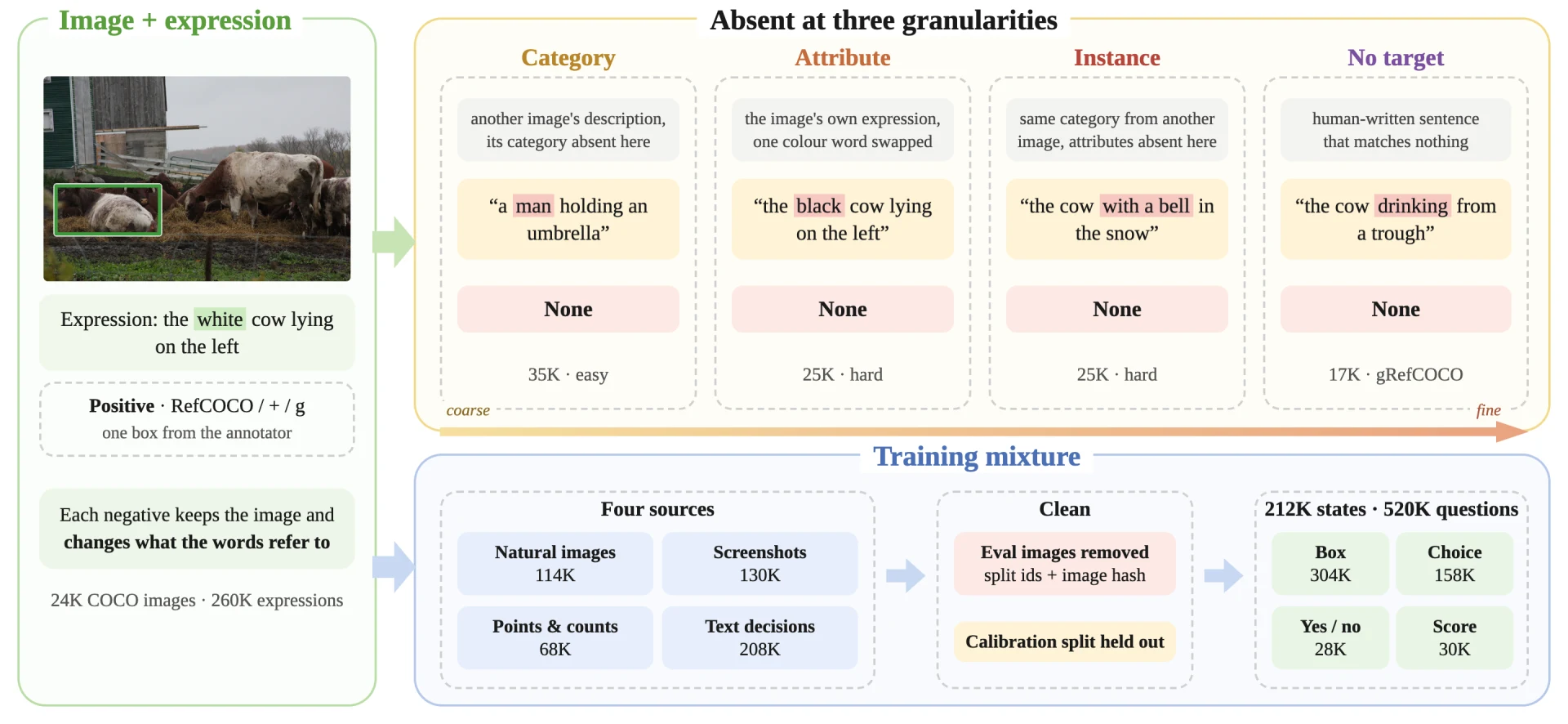
We build this supervision from the images RefCOCO already has. Each negative keeps the image and changes what the words refer to, at one of three granularities (Figure 1). We train a grounding model on it whose answer is a box together with a calibrated probability that the target is present, and which reads an image once for any number of questions (Figure 2). Our contributions:
- A negative-construction recipe that turns referring-expression data into absent descriptions at the category, attribute and instance level, using only the existing annotations.
- Glance-4B-preview, a grounding model that answers typed questions from one prefill through readout heads, with a presence probability, a box and a box confidence for every expression.
- An evaluation of the trade-off. The model is ahead of larger vision-language models on RefCOCO, rejects 87.4% of no-target expressions with well-calibrated probabilities, and, as a description-shift analysis shows, over-rejects coarse descriptions of objects that are present.
Related work
Referring-expression data. ReferItGame (Kazemzadeh et al., 2014) introduced the two-player game behind referring-expression collection; RefCOCO and RefCOCO+ (Yu et al., 2016) and RefCOCOg (Mao et al., 2016; Nagaraja et al., 2016) applied it to COCO (Lin et al., 2014) and remain the standard REC benchmarks. gRefCOCO (Liu et al., 2023) extended the task to expressions with several targets or none, and GREC (He et al., 2023) defined the corresponding box-level metrics. Described object detection (Xie et al., 2023) evaluates descriptions, including absent ones, across a whole dataset. We reuse these images and annotations and add negatives organised by granularity.
Grounding models. Specialist detectors condition box prediction on text: MDETR (Kamath et al., 2021) and Grounding DINO (Liu et al., 2024). Sequence models emit boxes as tokens: OFA (Wang et al., 2022) and vision-language models such as Shikra (Chen et al., 2023), Ferret (You et al., 2024), Qwen2.5-VL (Bai et al., 2025a) and Qwen3-VL (Bai et al., 2025b). These models generate one answer per prompt and express absence, if at all, as text. Glance keeps a vision-language backbone (Qwen Team, 2026) but replaces generation with readout heads, which gives every answer a probability and lets many questions share one prefill.
Negatives and compositionality. Vision-language models often behave like bags of words, matching the right nouns and ignoring attributes and relations (Yuksekgonul et al., 2023); hard negatives that swap words are the usual remedy for retrieval. For grounding, RC-GRPO (Yang et al., 2026) teaches a generative model to refuse with a refusal-calibrated variant of reinforcement learning. We instead build the negatives at fixed granularities in the data and read presence from a head trained with a proper scoring rule.
Method
We first describe the data (Section 3.1), then the model (Section 3.2) and its training (Section 3.3).
Data: absent at three granularities
Positives. We start from the 23,807 COCO training images (Lin et al., 2014) used by RefCOCO, RefCOCO+ and RefCOCOg, with their 260K human expressions and boxes.
Negatives. For each image we write descriptions that are false at exactly one granularity, using only the existing annotations:
- Category. An expression from another image whose COCO category does not occur in this image (“a man holding an umbrella” in a field of cows). These are easy and teach the model that the head noun matters (35K).
- Attribute. The image’s own expression with one colour word replaced by a colour that appears in none of the image’s expressions (“the black cow lying on the left”). Category, position and phrasing all still match; only the attribute is false (25K).
- Instance. An expression for an object of the same category, taken from another image, whose attribute words never occur in this image’s expressions (“the cow with a bell in the snow”). The right kind of object is present, but no instance fits the details (25K).
- No target. Human-written no-target expressions from gRefCOCO (17K).
Absent descriptions make up 28% of the natural-image pool, and 65% of them are hard (attribute, instance or human-written). The vocabulary checks are what make a swap false: a colour or attribute word counts as absent only if no annotator used it for anything in the image.
Mixture. Questions about natural images make up 114K of the 520K training questions. To keep the model useful beyond COCO, the rest come from GUI screenshots (Wu et al., 2024; Xu et al., 2024; Feizi et al., 2025) (130K), point and count annotations (Deitke et al., 2024) (68K, as box and count questions), and text-only choice, yes/no and score questions (Sileo, 2023) (208K). In total there are 212K states (an image or a text) and 520K questions: 304K box, 158K choice, 28K yes/no and 30K score, with 17.9% of box questions absent.
Decontamination. Every image that appears in any RefCOCO/+/g or gRefCOCO evaluation split is removed from training. This matters because RefCOCOg’s train split shares images with RefCOCO’s val and test splits. Evaluation images of other benchmarks are removed by perceptual hash. A further 600 natural images are held out as a calibration split and never trained on.
Model: one prefill, many questions
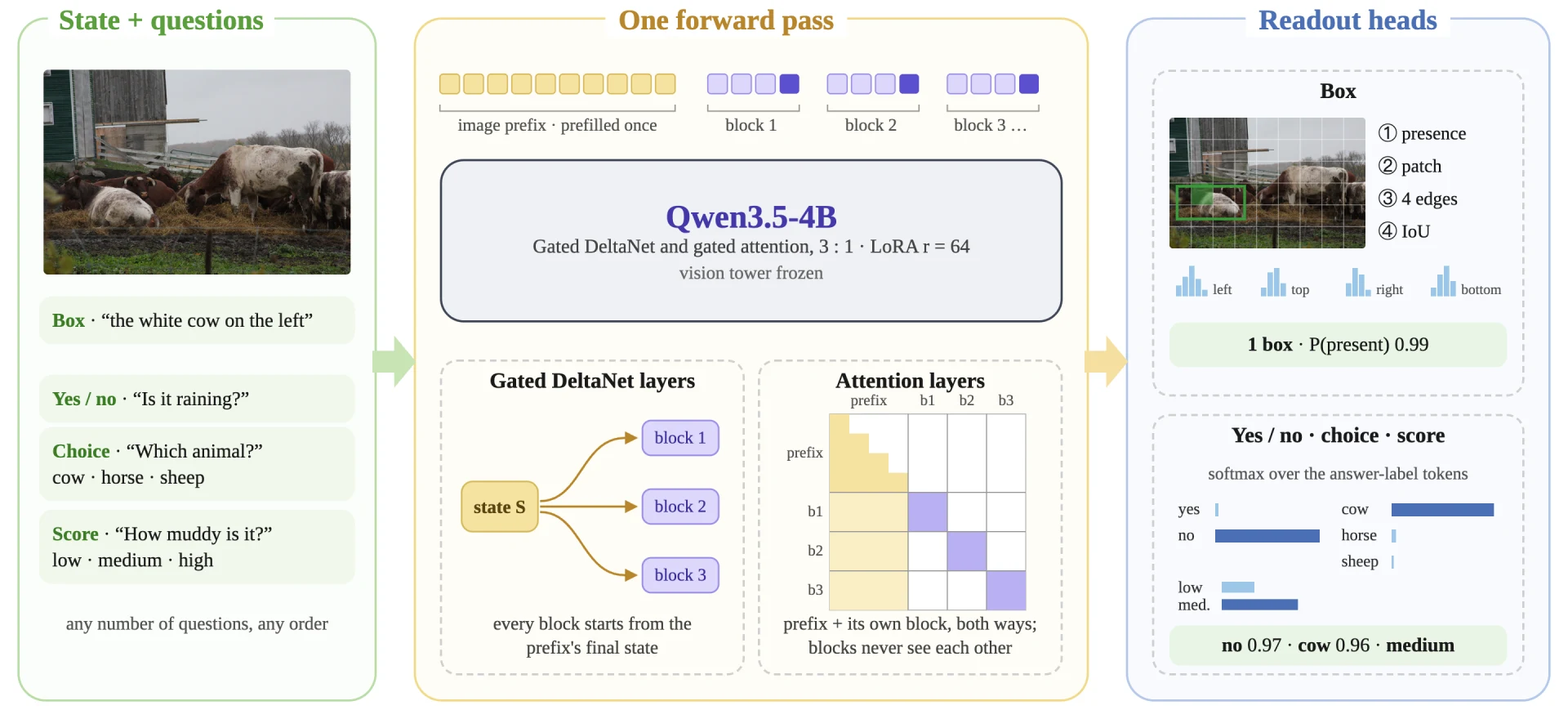
Backbone. Glance-4B-preview fine-tunes Qwen3.5-4B (Qwen Team, 2026), whose language model interleaves Gated DeltaNet layers (Yang et al., 2025) with gated attention at a ratio of 3 : 1. We train LoRA adapters (Hu et al., 2022) of rank 64 on every linear layer of the language model; the vision tower and embeddings stay frozen.
Shared prefix. The state, an image or a text, is prefilled once. Each question is appended as its own block and answered at its last token. In the attention layers a block attends to the prefix and, bidirectionally, to itself, but never to another block. In the Gated DeltaNet layers each block starts from the prefix’s final recurrent state. Questions therefore cannot leak into each other, and the answer to a question does not depend on which other questions were asked or in what order. Eight questions about a COCO image cost about the same as one.
Box head. From the readout vector , the box head predicts:
- a presence probability ;
- a distribution over image patches, whose target spreads mass over the patches covered by the ground-truth box in proportion to their overlap;
- four ordinal distributions over 64 bins for the left, top, right and bottom edges;
- the probability that the decoded box reaches IoU ≥ 0.5 with the target.
The answer is “not present” when ; otherwise it is the decoded box with confidence .
Typed heads. Choice, yes/no and score questions are answered by a softmax over the logits of their answer-label tokens: the language model’s own output rows plus a learned residual initialised at zero. A new set of options needs no new parameters.
Training
The box loss sums binary cross-entropy on presence, soft cross-entropy on the patch, a Cramér distance and a GIoU term on the edges, and binary cross-entropy on the IoU head; absent questions contribute only to presence. Choice and yes/no heads use soft cross-entropy plus a Brier term; score heads use cross-entropy plus a Cramér distance over the ordered labels. Presence and answer probabilities are trained with proper scoring rules, so they are pushed to be calibrated, not only ranked.
We train for one epoch (3,844 steps) with AdamW and a cosine schedule: learning rate for LoRA and for the heads, 100 warmup steps, and images resized to at most 640 visual tokens. Training takes 6.6 hours on one RTX PRO 6000. Afterwards we fit one temperature per head on the held-out calibration splits; no evaluation data is used.
Results
All Glance numbers are single-pass, with no test-time augmentation or second look, using bf16 and at most 640 visual tokens per image. Every evaluation image was removed from training. Numbers for other models are taken from their papers unless marked. Their prompts and resolutions differ from ours, so cross-model comparisons are indicative.
Referring expression comprehension
Table 1 reports Acc@0.5, the fraction of expressions whose box reaches IoU ≥ 0.5, on the eight standard splits. Glance-4B-preview is the best model in the table on all eight splits, with an 8-split mean of 90.8. Standard REC ignores presence. Requiring as well lowers RefCOCO val from 93.2 to 92.0: the negatives cost about one point of recall on clean positives.
| Model | RefCOCO | RefCOCO+ | RefCOCOg | |||||
|---|---|---|---|---|---|---|---|---|
| val | testA | testB | val | testA | testB | val | test | |
| MDETR | 87.5 | 90.4 | 82.7 | 81.1 | 85.5 | 73.0 | 83.4 | 83.3 |
| OFA-L | 90.1 | 92.9 | 85.3 | 85.8 | 89.9 | 79.2 | 85.9 | 86.6 |
| Grounding DINO-L | 90.6 | 93.2 | 88.2 | 82.8 | 89.0 | 75.9 | 86.1 | 87.0 |
| Shikra-7B | 87.0 | 90.6 | 80.2 | 81.6 | 87.4 | 72.1 | 82.3 | 82.2 |
| Ferret-7B | 87.5 | 91.4 | 82.5 | 80.8 | 87.4 | 73.1 | 83.9 | 84.8 |
| Qwen2.5-VL-3B | 89.1 | 91.7 | 84.0 | 82.4 | 88.0 | 74.1 | 85.2 | 85.7 |
| Qwen2.5-VL-7B | 90.0 | 92.5 | 85.4 | 84.2 | 89.1 | 76.9 | 87.2 | 87.2 |
| Qwen3.5-4B (base) | 91.4‡ | – | – | – | – | – | – | – |
| Glance-4B-preview | 93.2 | 94.5 | 90.7 | 89.7 | 93.3 | 84.6 | 90.0 | 90.4 |
Rejecting descriptions that match nothing
Table 2 measures the problem from the introduction directly. N-acc is the fraction of gRefCOCO no-target expressions the model rejects, with Glance rejecting when . Glance-4B-preview rejects 87.4 / 80.8 / 77.1% on val / testA / testB, ahead of every model we could compare against: its own base model rejects 65.0% on val, and Qwen3-VL-4B 77.2%.
The presence probability also ranks well. Pooled over gRefCOCO and RefCOCO val, its AUROC is 97.9, and its expected calibration error (15 bins) is 2.4%; that of the box confidence is 3.8%. A probability of 0.9 means about nine times in ten.
On the official GREC metric, Pr@(F1 = 1), Glance-4B-preview is close to Qwen3-VL-4B on val and well behind on testA and testB. This metric counts a sample as correct only when all its targets are found, and Glance-4B-preview returns one box per question, so every multi-target expression is wrong by construction; testA and testB contain many of them.
| Model | N-acc (no target) | Pr@(F1 = 1) | ||||
|---|---|---|---|---|---|---|
| val | testA | testB | val | testA | testB | |
| MCN | 30.6 | 32.0 | 30.3 | 28.0 | 32.3 | 26.8 |
| VLT | 35.2 | 34.1 | 32.5 | 36.6 | 40.2 | 30.2 |
| MDETR | 36.3 | 34.5 | 31.0 | 42.7 | 50.0 | 36.5 |
| UNINEXT | 50.6 | 49.3 | 48.2 | 58.2 | 46.4 | 42.9 |
| Qwen3.5-4B (base) | 65.0‡ | – | – | – | – | – |
| Qwen3-VL-4B | 77.2 | 70.2 | 70.2 | 72.4 | 68.0 | 62.2 |
| Glance-4B-preview | 87.4 | 80.8 | 77.1 | 71.6 | 47.5 | 51.3 |
Speed
Glance reads answers from heads instead of generating them, and every question shares one prefill, so a question costs a short block rather than a decoding loop. We serve Glance-4B-preview with Glance-Engine, our GPU inference engine, and compare it with vLLM 0.34 and SGLang 0.5.23 serving the base Qwen3.5-4B on the same requests: boxes decoded greedily (up to 24 tokens) and yes/no answers as one token with log-probabilities, with prefix caching and CUDA graphs on. All three run in BF16 on one RTX PRO 6000, and Figure 3 reports warm median latency.
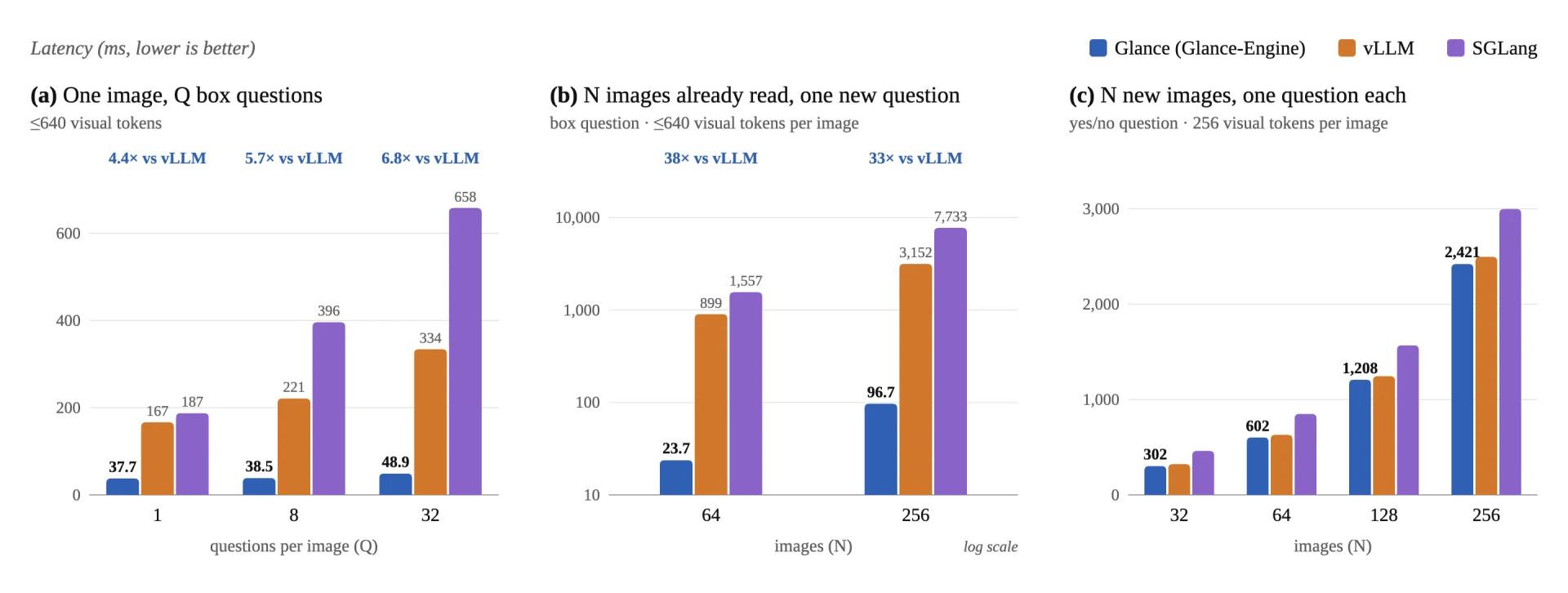
More questions per image. One box question takes 37.7 ms and 32 take 48.9 ms, against 166.5 and 334.0 ms for vLLM. The lead grows from 4.4× to 6.8× with the number of questions, because each extra question adds a short block to one batched pass instead of another decoding loop. vLLM with FP8 weights and speculative decoding, a lossy configuration, brings one question down to 99.2 ms, still 2.6× slower.
More images. Glance-Engine keeps the prefix state of every image it has read. A new question over 256 such images takes 96.7 ms: 33× faster than vLLM with prefix caching and 80× faster than SGLang. When the images are new, encoding them dominates and every engine does the same vision work. Glance-Engine is then 1.03–1.07× faster than vLLM and 1.2–1.5× faster than SGLang over 32 to 256 images.
Description shift
Rejecting the wrong descriptions is only half of granularity; the other half is accepting the right ones when they are worded differently. We take about 600 referents from the RefCOCO/+/g val splits and describe each several ways with a language model: a paraphrase, and a vague casual reference (“the guy on the left”). For 300 objects whose category is unique in their image we add two coarser descriptions: function only (“something to drink from”) and the supercategory alone. Accuracy here requires and IoU ≥ 0.5. We compare against the generative base model, whose confidence is its probability of not answering “absent”.
| Model | Present: accuracy by wording | Absent | All items | |||||
|---|---|---|---|---|---|---|---|---|
| Orig. | Para. | Vague | Func. | Super. | N-acc | Overconf. ↓ | ECE ↓ | |
| Qwen3.5-4B (base) | 88.6 | 88.9 | 83.6 | 79.0 | 53.8 | 63.5 | 18.2 | 20.0 |
| Glance-4B-preview | 88.6 | 88.1 | 83.6 | 59.2 | 43.5 | 88.0 | 3.7 | 2.9 |
Table 3 shows both sides of what the negatives teach. Wording that keeps the granularity of the original, a paraphrase or a vague reference, costs nothing. Glance rejects far more absent descriptions, and its wrong answers are rarely confident: 3.7% of answers are wrong with confidence above 0.8, against 18.2% for the base model. But descriptions coarser than the training expressions are often rejected. For function-only descriptions, 19% of present objects are called absent, against 3% for the base model.
The negatives taught the model that a word without a match in the image makes a description false. Nothing in the data taught it that a coarser word, a function or a supercategory, can still match. Semantic granularity runs in both directions, and our data covers one of them.
Conclusion
Referring-expression benchmarks reward a model for finding the right box without checking that it read the whole description. Building negatives at the category, attribute and instance level from the same images makes every granularity matter, and a readout head turns the answer into a probability that can be trusted. With one epoch of training on one GPU, Glance-4B-preview grounds better than larger vision-language models and rejects descriptions that match nothing far more reliably.
References
- Shuai Bai, Keqin Chen, Xuejing Liu, et al.. Qwen2.5-VL Technical Report. arXiv:2502.13923, 2025a.
- Shuai Bai, Yuxuan Cai, Ruizhe Chen, et al.. Qwen3-VL Technical Report. arXiv:2511.21631, 2025b.
- Keqin Chen, Zhao Zhang, Weili Zeng, et al.. Shikra: Unleashing Multimodal LLM's Referential Dialogue Magic. arXiv:2306.15195, 2023.
- Matt Deitke, Christopher Clark, Sangho Lee, et al.. Molmo and PixMo: Open Weights and Open Data for State-of-the-Art Vision-Language Models. arXiv:2409.17146, 2024.
- Aarash Feizi, Shravan Nayak, Xiangru Jian, et al.. Grounding Computer Use Agents on Human Demonstrations. arXiv:2511.07332, 2025.
- Shuting He, Henghui Ding, Chang Liu, and Xudong Jiang. GREC: Generalized Referring Expression Comprehension. arXiv:2308.16182, 2023.
- Edward J. Hu, Yelong Shen, Phillip Wallis, et al.. LoRA: Low-Rank Adaptation of Large Language Models. ICLR, 2022.
- Aishwarya Kamath, Mannat Singh, Yann LeCun, et al.. MDETR: Modulated Detection for End-to-End Multi-Modal Understanding. ICCV, 2021.
- Sahar Kazemzadeh, Vicente Ordonez, Mark Matten, and Tamara L. Berg. ReferItGame: Referring to Objects in Photographs of Natural Scenes. EMNLP, 2014.
- Tsung-Yi Lin, Michael Maire, Serge Belongie, et al.. Microsoft COCO: Common Objects in Context. ECCV, 2014.
- Chang Liu, Henghui Ding, and Xudong Jiang. GRES: Generalized Referring Expression Segmentation. CVPR, 2023.
- Shilong Liu, Zhaoyang Zeng, Tianhe Ren, et al.. Grounding DINO: Marrying DINO with Grounded Pre-Training for Open-Set Object Detection. ECCV, 2024.
- Junhua Mao, Jonathan Huang, Alexander Toshev, et al.. Generation and Comprehension of Unambiguous Object Descriptions. CVPR, 2016.
- Varun K. Nagaraja, Vlad I. Morariu, and Larry S. Davis. Modeling Context Between Objects for Referring Expression Understanding. ECCV, 2016.
- Qwen Team. Qwen3.5: Towards Native Multimodal Agents. Blog post, 2026.
- Damien Sileo. tasksource: A Dataset Harmonization Framework for Streamlined NLP Multi-Task Learning and Evaluation. arXiv:2301.05948, 2023.
- Peng Wang, An Yang, Rui Men, et al.. OFA: Unifying Architectures, Tasks, and Modalities Through a Simple Sequence-to-Sequence Learning Framework. ICML, 2022.
- Zhiyong Wu, Zhenyu Wu, Fangzhi Xu, et al.. OS-ATLAS: A Foundation Action Model for Generalist GUI Agents. arXiv:2410.23218, 2024.
- Chi Xie, Zhao Zhang, Yixuan Wu, et al.. Described Object Detection: Liberating Object Detection with Flexible Expressions. NeurIPS, 2023.
- Yiheng Xu, Zekun Wang, Junli Wang, et al.. Aguvis: Unified Pure Vision Agents for Autonomous GUI Interaction. arXiv:2412.04454, 2024.
- Songlin Yang, Jan Kautz, and Ali Hatamizadeh. Gated Delta Networks: Improving Mamba2 with Delta Rule. ICLR, 2025.
- Xuzheng Yang, Jun Ling, Tao Huang, Caiyan Qin, and Peng Wang. Teaching MLLMs to Say No: Generalized Referring Expression Comprehension via Refusal Calibrated GRPO. arXiv:2608.04698, 2026.
- Haoxuan You, Haotian Zhang, Zhe Gan, et al.. Ferret: Refer and Ground Anything Anywhere at Any Granularity. ICLR, 2024.
- Licheng Yu, Patrick Poirson, Shan Yang, Alexander C. Berg, and Tamara L. Berg. Modeling Context in Referring Expressions. ECCV, 2016.
- Mert Yuksekgonul, Federico Bianchi, Pratyusha Kalluri, Dan Jurafsky, and James Zou. When and Why Vision-Language Models Behave like Bags-of-Words, and What to Do About It?. ICLR, 2023.
Citation
If you find this work useful, please cite it as:
@misc{zhang2026glance,
  title  = {{Glance: Box Grounding at the Granularity of the Words}},
  author = {Zhang, Qian and Gao, Zexuan},
  year   = {2026},
  url    = {https://happyfox.dev/blog/glance/},
  note   = {Blog post}
}